Potassium Cation Competition
How Excess Potassium Starves Plants of Essential Nutrients
Potassium is essential for plant growth, but more is not always better. When potassium is applied in excess, it physically blocks the uptake of other critical nutrients — particularly calcium and magnesium — even when those nutrients are plentiful in the soil. This phenomenon, known as cation competition, is one of the most widespread yet underrecognized causes of nutrient deficiency in modern agriculture. A growing body of research reveals that the damage extends beyond the root surface, disrupting nutrient transport within the plant, impairing photosynthesis, and ultimately reducing both yield and crop quality.
How Cation Competition Works
Plant roots absorb positively charged nutrients — called cations — through protein channels and transporters embedded in root cell membranes. Potassium (K⁺), calcium (Ca²⁺), and magnesium (Mg²⁺) all compete for entry through many of the same doorways. Some of these transporters are highly selective for potassium, but others are non-selective cation channels that will admit whichever cation arrives first at the highest concentration.
Potassium has a built-in advantage in this competition. It has the largest ionic radius of the common soil cations, which gives it weaker electrostatic interactions with water molecules. In practical terms, this means potassium moves faster through soil solution and arrives at root surfaces more readily than calcium or magnesium. Once there, it is taken up efficiently by both high-affinity and low-affinity transport systems.
Research by Xie and colleagues (2021) has identified specific molecular channels where this competition plays out. Non-selective cation channels (NSCCs) in root membranes transport both potassium and magnesium. Certain potassium transporters in the HKT family, originally thought to be potassium-specific, have been shown to also transport magnesium — but potassium competes for and wins these binding sites when both nutrients are present. Even dedicated magnesium transporters can be blocked when potassium concentrations in the soil solution are high.
A One-Way Street
One of the most important findings from recent research is that the competition between potassium and magnesium is not equal. Potassium’s antagonistic effect on magnesium uptake is far stronger than the reverse. Increasing potassium concentrations in the growth medium consistently reduces magnesium uptake across virtually all plant species studied — from rice and wheat to banana and citrus.
Magnesium, by contrast, has little to no effect on potassium uptake. This asymmetry exists because potassium is absorbed through highly specific, high-affinity transport systems that magnesium cannot easily block, whereas magnesium relies more heavily on the non-selective channels that potassium dominates. As Xie and colleagues put it, the specific potassium transporters in root cells are simply "not competitively blocked by magnesium."
The practical consequence is stark: overapplying potassium reliably induces magnesium deficiency, but adding more magnesium does little to counteract potassium’s dominance. The imbalance must be addressed at the source — by reducing excess potassium.
Beyond the Root: Disrupted Transport
The damage from excess potassium does not stop at the root surface. Research shows that high potassium also inhibits the transport of magnesium from roots to shoots through the plant’s vascular system. In tomato, the ratio of potassium to magnesium in shoots was significantly higher than in roots under high-potassium conditions, indicating that potassium suppresses magnesium loading into the xylem — the vessels that carry nutrients upward to leaves and fruit.
Within the plant, the antagonism is most severe in older, mature leaves. These established leaves — the ones doing most of the photosynthesis and exporting sugars to the rest of the plant — show the strongest competition between potassium and magnesium. Younger growing leaves and developing fruit, by contrast, may actually show a positive relationship between the two nutrients, because both are preferentially delivered to actively growing tissues. This pattern means that the visible signs of magnesium deficiency — interveinal chlorosis, where leaf tissue yellows between the veins while the veins themselves remain green — typically appear first on older leaves, even as younger leaves look healthy. By the time symptoms become obvious, the internal nutrient balance has been disrupted for some time.
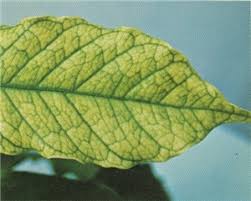
Interveinal chlorosis: the hallmark symptom of magnesium deficiency. Yellowing appears between the veins of older leaves first, because excess potassium blocks magnesium transport to these established leaves while younger leaves are still preferentially supplied.
The Hidden Cost of Excess
What makes cation competition particularly insidious is that soil tests may show adequate levels of calcium and magnesium. The problem is not in the soil but at the root surface and within the plant, where potassium outcompetes other cations for uptake and transport.
This means that conventional soil-test-based fertilizer recommendations can miss the problem entirely. A grower may see calcium deficiency symptoms, add more calcium, and see no improvement — because the underlying issue is excessive potassium blocking uptake. K-induced magnesium deficiency is so common that researchers have documented it across tropical and subtropical regions worldwide, particularly in crops with high potassium demand such as banana, potato, and sugarcane.
In greenhouse vegetable production in North China, for example, heavy potassium fertilization has pushed soil-available potassium above 600 mg/kg — more than double the optimum range — even in calcareous soils naturally rich in magnesium. The result is widespread magnesium deficiency that growers and crop advisors often fail to recognize because it does not fit the expected pattern of nutrient-poor soils.
Synergies Lost When Balance Breaks
The irony of potassium-magnesium antagonism is that when these two nutrients are in proper balance, they work together to support critical plant functions. Both are required for photosynthesis: potassium regulates stomatal opening to allow gas exchange, while magnesium sits at the center of every chlorophyll molecule and activates RuBisCO, the enzyme that fixes carbon dioxide.
Both nutrients are also essential for phloem loading — the process of moving sugars from leaves to fruits, roots, and seeds. Potassium activates the proton pumps that drive sugar loading into the phloem, while magnesium provides the Mg-ATP energy that powers these pumps. When either nutrient is deficient, sugars accumulate in leaves instead of reaching the fruits, tubers, and seeds where they contribute to yield and quality.
Balanced potassium and magnesium also cooperate in nitrogen metabolism. Both activate enzymes required for converting nitrate into amino acids and proteins. Magnesium can even partially substitute for potassium in some of these reactions. But this functional synergy only operates when both nutrients are available in appropriate proportions — a condition that excess potassium fertilization directly undermines.
The Ratio Solution
Research consistently shows that crop yield and quality depend more on the ratio of potassium to magnesium than on the absolute amount of either nutrient alone. In potato trials, maximum tuber yields were achieved at a K/Mg fertilizer ratio of 3:1, while the highest starch concentrations — reflecting superior tuber quality — occurred at a ratio of 1.6:1. In rubber trees, optimal growth occurred when the K/Mg ratio in soil was 2:1 and in leaves was 3:1.
These ratios vary by crop and soil type, but the principle is universal: balanced nutrition requires not just adequate levels of individual nutrients, but appropriate ratios between competing cations. When potassium is applied in excess, restoring these ratios becomes the critical challenge — and the most effective intervention is often to reduce potassium inputs rather than to add more of the nutrients it is displacing.
Broader Consequences
The problem of potassium overapplication extends beyond individual fields. Sardans and Peñuelas (2021) document that global potassium fertilizer use has tripled since 1961, with some regions — particularly in China — applying potassium far in excess of crop needs. This overfertilization not only wastes a finite mined resource but also disrupts uptake of nitrogen, magnesium, and iron through competitive exclusion, while potassium lost to leaching contaminates surface waters and groundwater.
At the same time, many developing regions cannot access adequate potassium fertilizer, creating a global imbalance in which some soils are saturated while others are depleted.
Research by Khan, Mulvaney, and Ellsworth (2014) at the University of Illinois raises an even more fundamental question: whether potassium fertilization is necessary at all in many soils. Their analysis of over 2,100 yield-response trials found that potassium chloride (KCl) fertilization — the most common form of potassium fertilizer — was unlikely to increase crop yield in the majority of cases, and in more than 1,400 field trials it actually had a detrimental effect on crop quality. The reason, they argue, is that most agricultural soils already contain roughly 40,000 pounds of potassium per acre in just the top six inches. Standard soil tests measure only the exchangeable fraction and cannot account for the highly dynamic interchange between exchangeable and non-exchangeable potassium reserves, leading to recommendations for fertilizer that the soil does not actually need.
When unnecessary potassium is applied anyway, the consequences compound: the excess potassium blocks uptake of calcium, magnesium, and other cations through the competitive mechanisms described above, while the chloride component of KCl can damage soil biology and crop quality. The solution starts with the same principle in every case — matching potassium application to actual crop needs and maintaining proper cation ratios, rather than applying nutrients by default.
Visible Symptoms of Cation Imbalance
- Interveinal chlorosis on older leaves (magnesium deficiency)
- Blossom end rot in tomatoes and peppers (calcium deficiency)
- Tip burn in lettuce and leafy greens (calcium deficiency)
- Reduced fruit sugar content and storage life
- Weakened cell walls and increased disease susceptibility
- Impaired phloem loading — sugars accumulate in leaves instead of reaching fruit